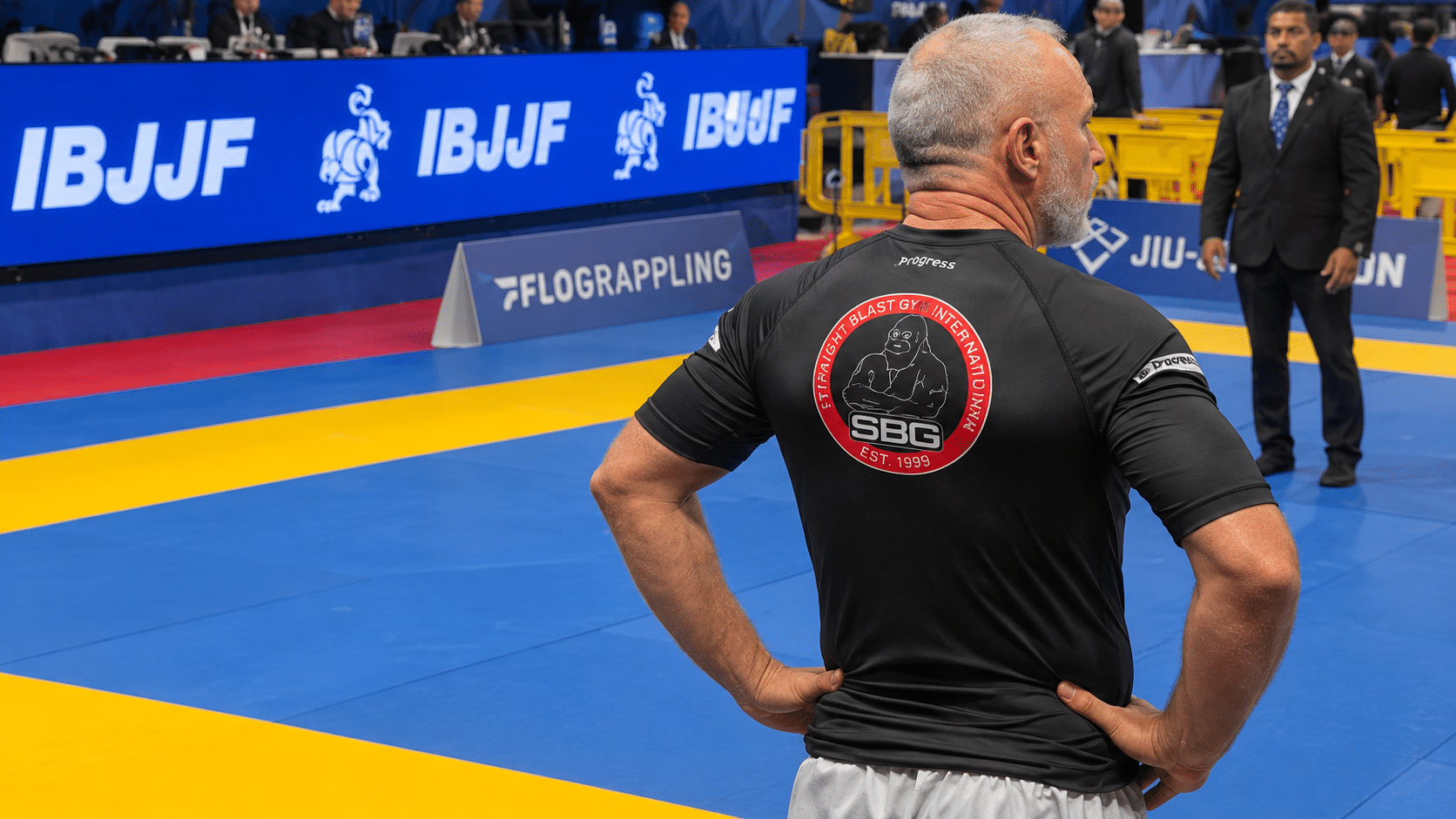
This week, I won gold at the European No-Gi Jiu-Jitsu Championships in Rome.
I’m proud of that. I now have European No-Gi gold medals at brown belt and black belt, and I’d still like to add a black belt gi gold to the collection.
But the medal only shows you a small part of the story.
It doesn’t show you the mornings when walking downstairs is uncomfortable. Or when making a fist hurts. Or the daily decisions involved in training around an autoimmune condition, chronic pain and a shoulder that currently has several things wrong with it.
Those things are part of my everyday life. They influence what I can do and how I approach it.
They also help explain why the words “Refuse Decline. Become the Exception.” mean something to me.
What am I actually refusing?
Getting older brings changes. I feel them. Training and competing past 40 is demanding, and I’m a long way past that now.
Some abilities become harder to maintain. Recovery can take longer. Illness and injury can change your plans, sometimes permanently.
When I say “refuse decline,” I mean questioning the assumption that those changes should decide the whole direction of your life.
Do I have to stop learning because I’m older? Does a diagnosis get to determine every ambition I have? If I can’t do something the way I used to, is there another way to approach it?
Sometimes the answer involves working harder. Sometimes it involves changing the plan, getting help or giving yourself time to recover.
The important thing is to remain involved in those decisions rather than automatically writing yourself off.
Real limitations deserve respect
There’s a phrase people use in motivational content: “Your only limits are the ones you place on yourself.”
I don’t believe that.
People have real limitations. Health, disability, money, caring responsibilities and access to support all affect what is possible. Pretending otherwise makes for an easy slogan, but it doesn’t help someone dealing with those circumstances.
My own decision to compete was personal. It tells you nothing about what another person with the same condition should be able to do.
What interests me is the space between the constraints we genuinely face and the conclusions we draw from them.
“I need to approach this differently” leaves room to explore.
“There’s no point trying” closes that room before we know what might be possible.
I think that difference is worth examining.
Other people helped me see it
In Rome, I met people competing in their 50s and 60s whose health challenges put my own into perspective.
Their determination encouraged me. We were all there with different bodies, different histories and different reasons for competing.
You rarely see everything it took for someone to step onto that mat.
The same is true elsewhere. Someone returning to work, joining a class or going for a short walk might be doing something that required months of preparation and a great deal of courage.
Visible achievement gives us very little information about the effort behind it.
That’s why I’m cautious about presenting my medal as proof of what anyone else can do. I hope it offers encouragement, but your challenge and your starting point will be your own.
Capability needs a reason
Jiu-jitsu matters to me. I enjoy learning it, teaching it, testing myself and being part of the community around it.
That gives me reasons to look after my health and keep developing my skills. It also gives me reasons to adapt when something becomes difficult.
This is where the Five Pathways within Beyond Human come together.
Health helps me participate. Mindset influences how I respond to difficulty. Growth keeps me learning. Connection gives me coaches, training partners and people who care. Purpose helps me understand why I want to continue.
My gold medal involved all five.
Chris Coltrane, Casey Jones, Saul Rogers and my SBG Manchester family and team all contributed to the journey. The support, coaching and countless rounds with other people are part of that result.
Personal effort matters, and so do the people who make that effort possible.
You don’t need to practise martial arts to recognise those connections. They can exist in caring for a family, learning music, volunteering, building a business or spending time outdoors.
The pathways are simply a guide for noticing what supports the life you want. You can adapt them, rename them or use different headings altogether.
You still have to participate
Beyond Human asks you to put ideas into practice.
Thinking about a change can help you understand what you want. Planning can help you work out where to begin. Eventually, though, something has to happen.
You practise the skill. Make the appointment. Have the conversation. Ask for support. Take the first manageable step.
There is no promise that effort will deliver everything you want. I could have prepared for Rome and come home without a medal. That would have been disappointing, but it wouldn’t have erased the learning, relationships or work involved in getting there.
A result matters. So does what the process contributes to your life.
What does “become the exception” mean?
For me, it means being willing to question an expectation that has been handed to you—or one you’ve quietly adopted yourself.
Perhaps you’ve decided learning belongs to younger people. Perhaps you’ve stopped making plans because your circumstances have changed. Perhaps you assume everyone else starts with confidence and you’re the only one who feels uncertain.
Those beliefs deserve a closer look.
You might discover that a goal needs adjusting. You might find a different activity that gives you what you were looking for. You might also find that you’re capable of more than you expected.
There’s room for all of those outcomes.
You don’t need a podium finish to make this meaningful. Maintaining your independence, rebuilding a friendship, returning to something you enjoy or finding a new direction can matter enormously.
Where could you begin?
Think about something you still want to do.
What is making it difficult? Which parts of that difficulty could you influence? What support would help? Is there a smaller or more suitable version you could begin with?
Give those questions an honest answer, including the uncomfortable practical details.
Then choose a step that fits your life as it is now.
I’m pleased I stepped onto the mat in Rome. I’m grateful to the people who helped me get there, and proud of the result.
What I hope someone takes from it is permission to reconsider a possibility they may have dismissed too quickly.
Refuse Decline. Become the Exception.